> For the complete documentation index, see [llms.txt](https://docs.oort.io/llms.txt). Markdown versions of documentation pages are available by appending `.md` to page URLs; this page is available as [Markdown](https://docs.oort.io/understanding-your-users/user-360.md).
# User 360
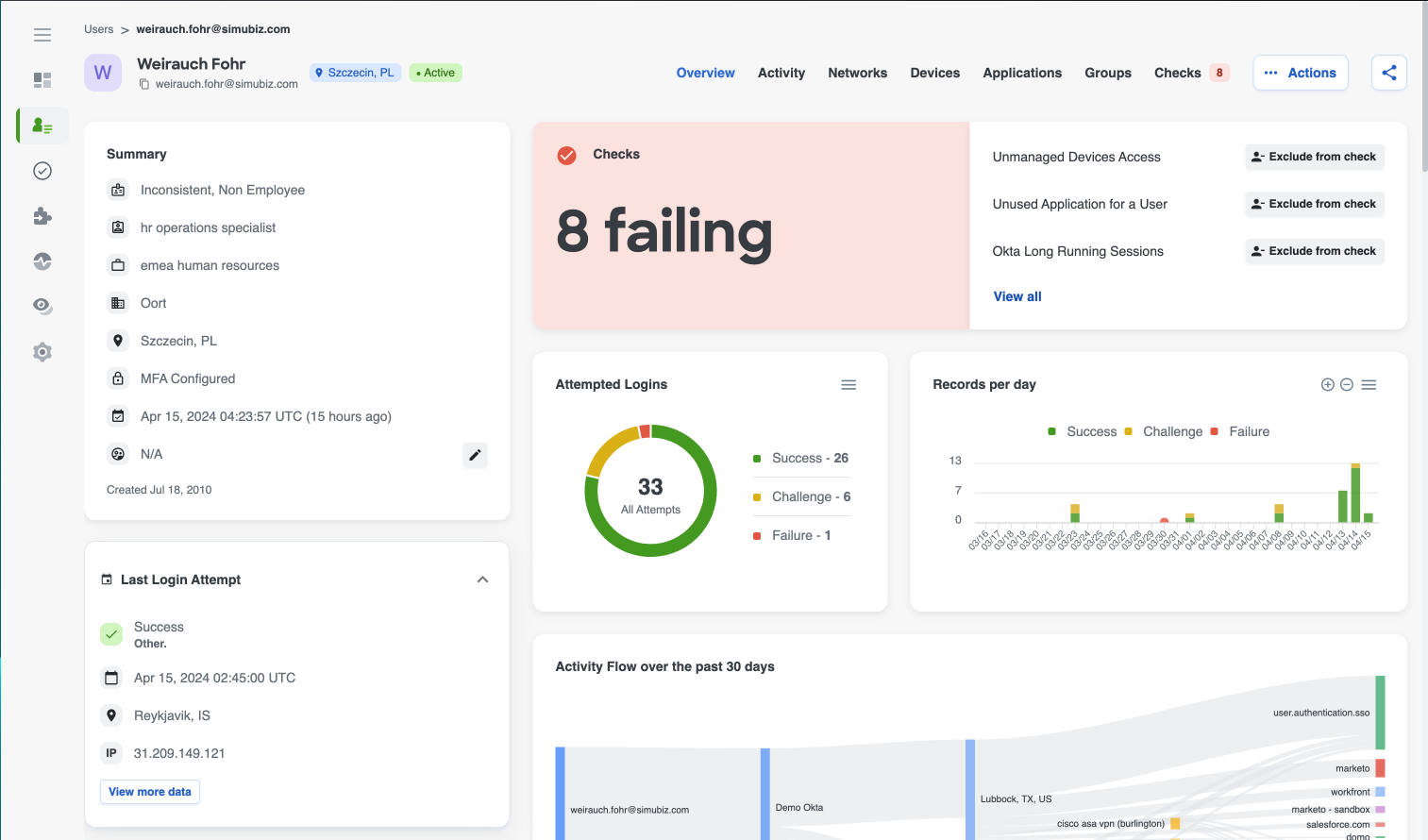
With Identity Intelligence's User 360 View, you get rich insight across distinct data sources about each and every identity in your user population. The User 360 profile consolidates a user's static entitlement data with dynamic behavior and user event logs to create a single source of truth across all sources (Entra ID, Duo, Github, Workday, etc) for any given identity.
All of this information is gathered from each source where the same user email has been associated and is then displayed across various areas of the User 360 to provide you with deep context on a particular identity.
To get to a User 360, select a specific user's name from the [Users](/understanding-your-users/users.md) page, the failing users on a specific [Check](/understanding-check-failures.md) page, the [System Logs](/oort-tenant-settings-overview/systems-logs.md), etc - basically anywhere in the platform where you see a user's email in a blue hyperlink! To open the User 360 in a new tab, use the grey button next to the user's email.
The User 360 is broken down into multiple tabs. To learn more about what information and functionality is available in each tab, use the respective link for each page below:
* [Overview](/understanding-your-users/user-360/overview-tab.md) tab
* [Activity](/understanding-your-users/user-360/activity-tab.md) tab
* [Networks](/understanding-your-users/user-360/networks-tab.md) tab
* [Devices](/understanding-your-users/user-360/devices-tab.md) tab
* [Applications](/understanding-your-users/user-360/applications-and-groups-tabs.md) tab
* [Groups](/understanding-your-users/user-360/applications-and-groups-tabs.md) tab
* [Checks](/understanding-your-users/user-360/checks-tab.md) tab
Some information and functionality persists across all tabs of the User 360. Some of these fields can be seen in the screenshot below. The full list of fields that you may see in this section are:
* User's display name - Top left corner
* User's email - Top left corner, under display name
* User's registered location, if present in the IdP or HRIS - Blue tag next to display name and email
* \# of Linked users, if present - Blue tag next to display name and email, and registered location tag, if present
* User's [Identity Intelligence Status](/understanding-your-users/user-statuses.md) - Tag (color depending on user's status) next to display name and email, and registered location tag, if present
* User Lifecycle events, if applicable - Yellow tag next to display name and email, and registered location tag, if present. For users with a Significant Event tag, hover over the tag to see a tooltip with the event types. See [Overview](/understanding-your-users/user-360/overview-tab.md) tab for more information about the different lifecycle events
Functionality that persists across all tabs are:
* **Actions** button - [Read the linked documentation to learn more about remediation actions](/understanding-your-users/remediation-actions.md#remediation-actions)
* **Share** button - Use the **Share** button on the right side of the page, after all the tabs to copy a link to the exact page that can be easily pasted, bookmarked or shared with anyone who has the appropriate access to your Identity Intelligence tenant.
{% embed url="" %}