> For the complete documentation index, see [llms.txt](https://docs.oort.io/llms.txt). Markdown versions of documentation pages are available by appending `.md` to page URLs; this page is available as [Markdown](https://docs.oort.io/integrations/email-notifications.md).
# Email Notifications
08/2024
Email notifications are one of the quickest and easiest ways to get started with outbound notifications for Cisco Identity Intelligence.
## Setup
Setting up an email notification target requires the full administrator role.
1. From the Integrations page, click Add Integration.
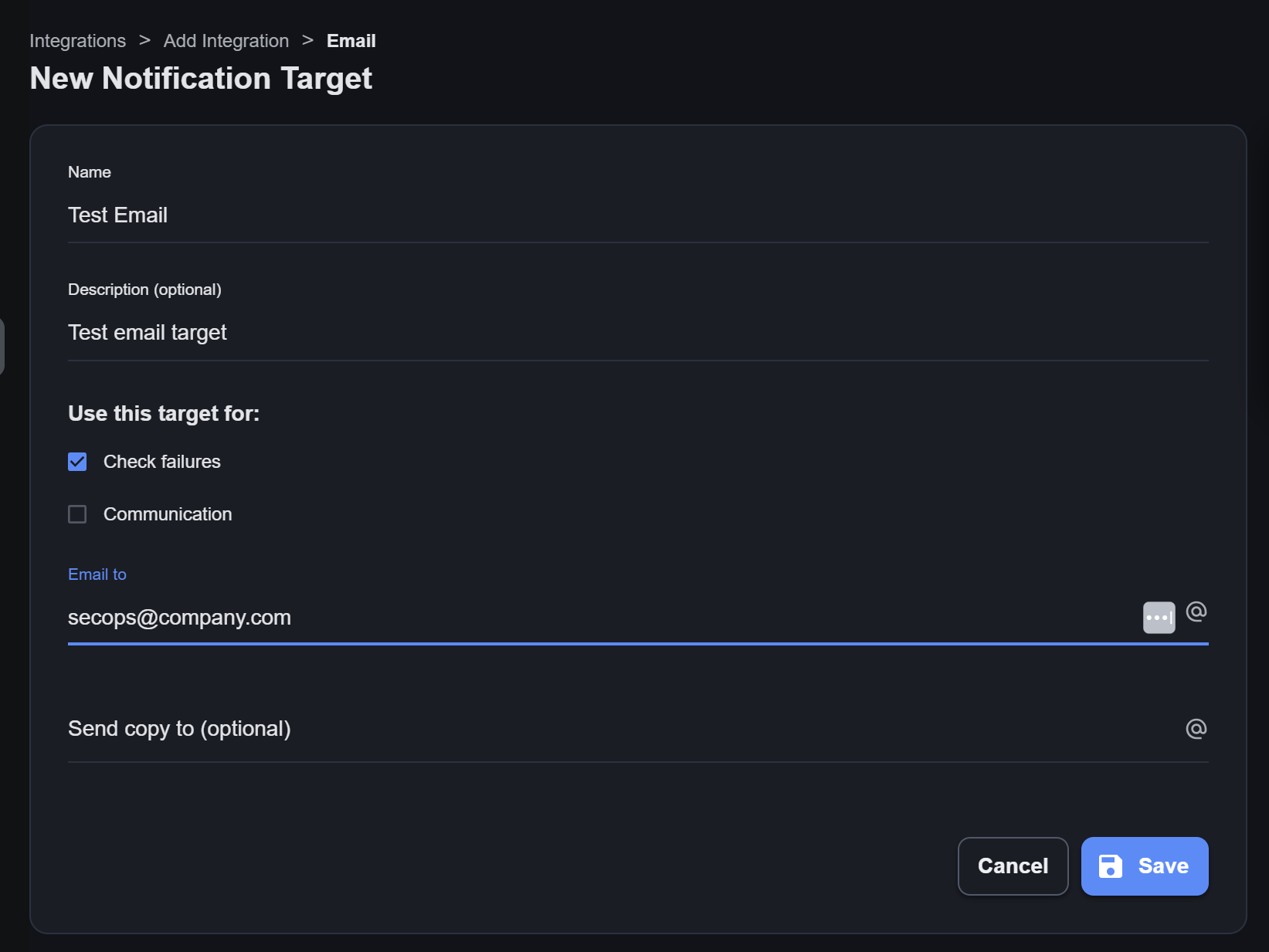
2. Select Add Email Target
3. Enter a target display name and description, if desired
4. Choose the desired notification types to send to the notification target. A notification target can be used for one or multiple purposes. There are 3 options available:
* Check Failures - Notification Target will be used to alert on check failures where the target is configured via the[ Check Settings](/understanding-check-failures/customizing-checks.md#notification-settings)
* Data Collection - Notification Target will be used to alert when errors are encountered when collecting data from the integrations or when an on-demand collection is finished (via "Collect Now" button for an integration)
* Communication - Notification Target will be used as the "Reply-To" header value to the address in the configured notification target instead of a generic no-reply Identity Intelligence email address. Learn more in the [Mailgun](/integrations/mailgun-integration.md) or [SendGrid](/integrations/sendgrid-integration.md) documentation
5. Enter the email address or distribution list, and any additional copy-to addresses. Use a comma-separated list to support multiple addresses
* **Select Checks Manually**: Check the box next to everything to check for. Use the search field to search for checks by name.\
\
When you're finished, click **Add Checks** and select the check box next to each check to add.
* **Select Checks by Category**: Check the box next to every Severity (or click **All** to select all severities), then check the box next to every **Topic** (or click **All** to select all topics).\
\
Example:
5. Select **Save**
6. To test the new target from the Integrations page, select the 3-dot menu for it on the right and select **Test Connectivity**
## Add the Email Target to One or More Checks
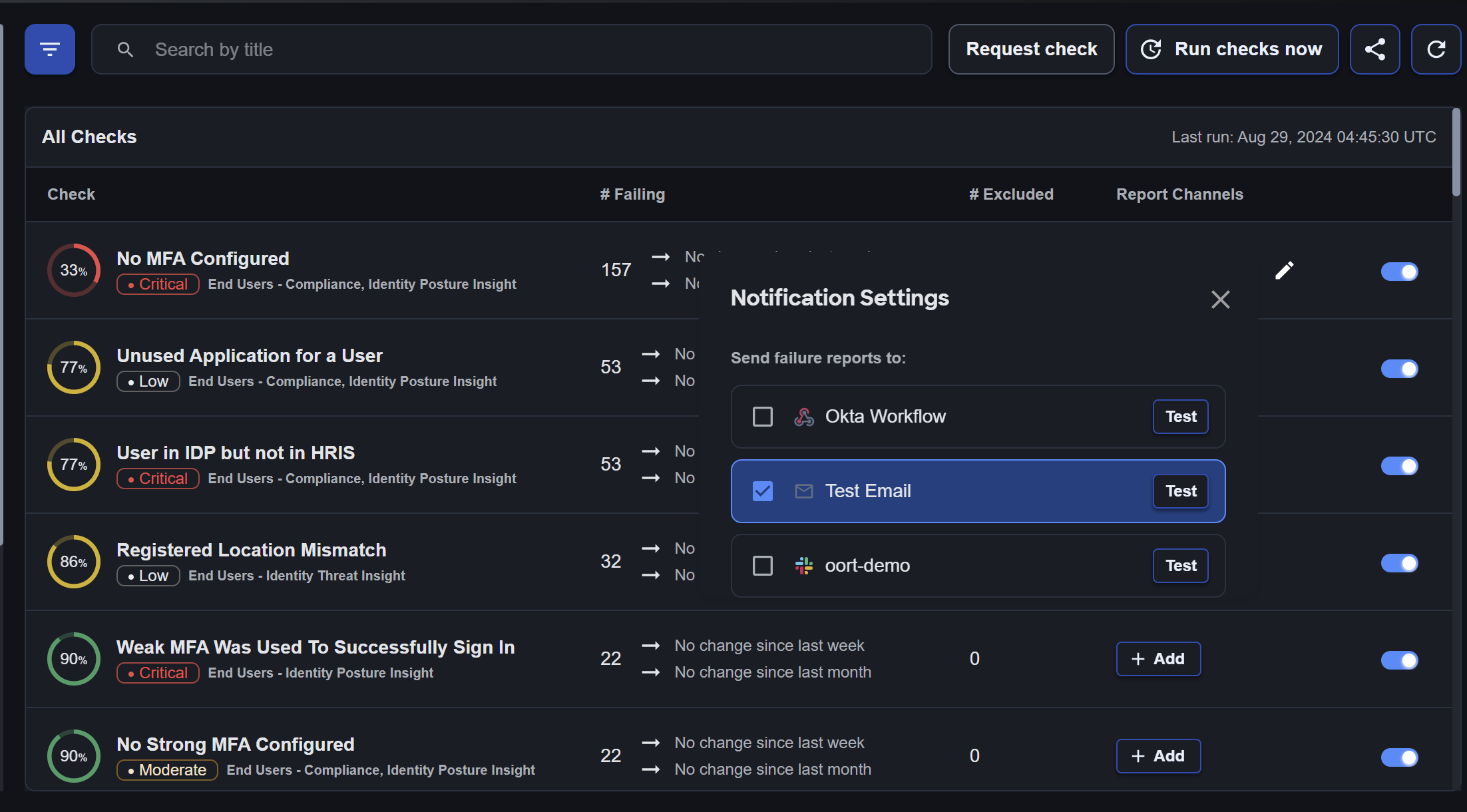
1. With the new email notification target in place, navigate to the Checks page.
2. Select the **Add +** button in the column and select one or more Checks where you would like email notifications for new failing users. You can also test the functionality from this point
## Notification Format and Frequency
Email notifications differ slightly from chat app notifications like [Slack](/integrations/slack-notification-integration.md) and [Microsoft Teams Notification](/integrations/microsoft-teams-notification-integration.md) in the following way:
1. By default, **one** email is sent per check per day, with a summary report of up to 20 users.
2. If more than 20 new users failed that particular check in a 24 hr period, then use the "See Report" link at the bottom of the email to view the list of users in the Identity Intelligence dashboard